In May this year we spent a few days in Antwerp, Belgium (travelling entirely by train! Very satisfying). One reason for the trip was to visit the home and workshop (now a printing museum) of Christophe Plantin, 1520-1589. My husband trained as a graphic designer and over his career has become very experienced with the whole process of printing books. As a proofreader, I too have learned the specific details of how books are published.
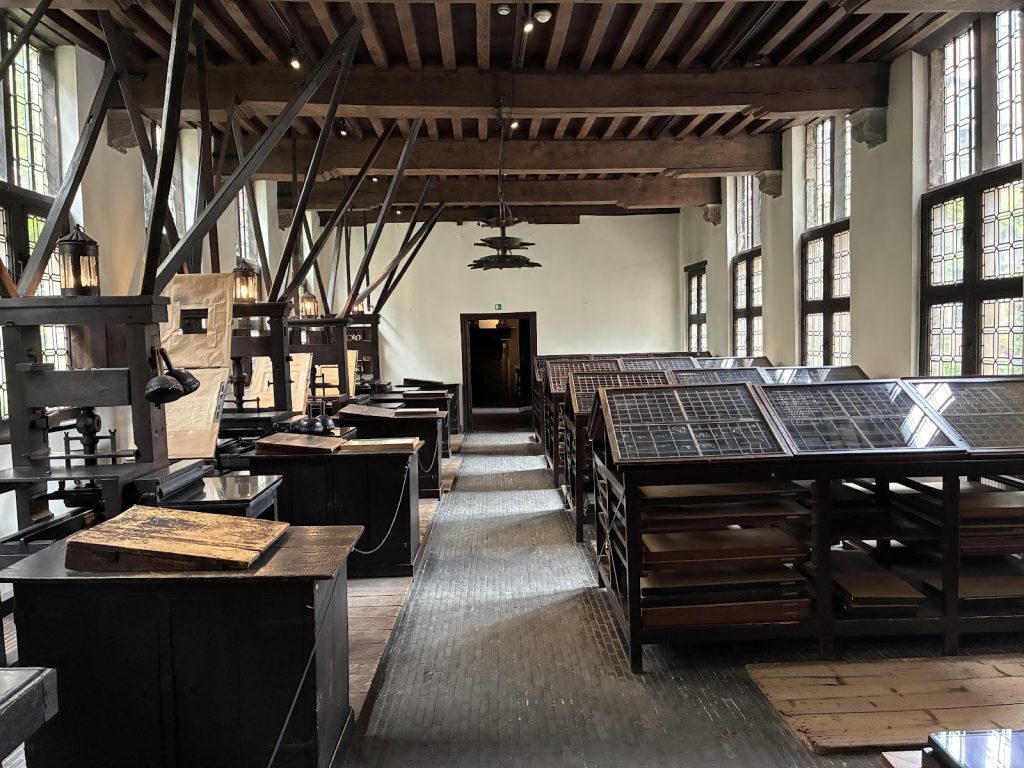
This museum – a UNESCO World Heritage Site since 2005 – has an exceptional collection of typographical materials, and holds the world’s two oldest surviving printing presses. And there’s an extra reason for a New Church person to appreciate it – the reason the Word was given to this planet, of all those in the universe, was because eventually PRINTING developed here. Isn’t that amazing?
“The Word could be written in our world, because the art of writing existed here from the most ancient times, at first on tablets, then on parchment, later on paper, and finally it could be disseminated in print. The Lord’s providence caused this for the sake of the Word.” Worlds in Space 115
“The art of printing is indeed a sort of Messiah amongst inventions.” Georg Christoph Lichtenberg
“The invention of printing is the greatest event in history. It is the mother of all revolution, a renewal of human means of expression from its very basis. Printed thoughts are everlasting, provided with wings, intangible and indestructible. They soar like a crowd of birds, spread in all four directions and are everywhere at the same time.” Victor Hugo
“The whole world admits unhesitatingly, and there can be no doubt about this, that Gutenberg’s invention [the printing press] is the incomparably greatest event in the history of the world.” Mark Twain
As we wandered through the rooms we learned more and more about what this printing house accomplished. There were replicated books we could leaf through – maps, Bibles, philosophical discourses, illustrated natural history books, dictionaries; pages showing three or more languages all saying the same thing; actual pages of very old books and documents (including a double spread of marked-up proofs: the proofreading symbols used in 1560 are virtually the same as those I have used! Despite not having a clue what the words were, I could understand what was being corrected, and how); real typecases filled with rows of real metal type, in different alphabets, in a room full of real printing presses.
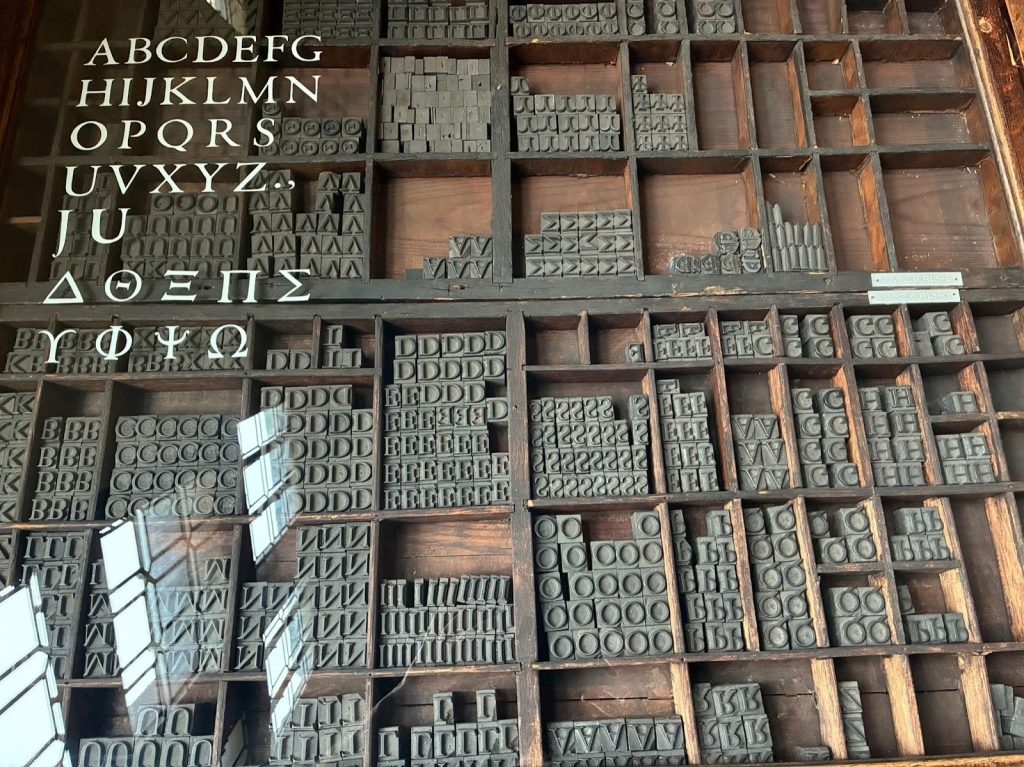
There were videos showing how metal type was made – a surprisingly detailed and intricate process – and working models you could have a go with. The tools of the printing trade are myriad, and the number of different skills needed by people working there was astonishing. Getting a leaflet, let alone a book, from idea to publication was complicated back in the 16th century: those who undertook to do that work were skilled and dedicated craftsmen and women.
By the time we finished (3 hours later!) we’d become more deeply aware that this process – printing – was a vital part of the spread of knowledge throughout the world, from the Reformation through to the Age of Enlightenment. It produced a virtual explosion of information, made accessible to far more people than verbal stories or hand-copied manuscripts could reach. Sebastian Brant, a 16th century poet, said, “What the rich man of yesterday and the king possessed are now found even in the most modest of homes, namely a book. Thanks first be to the gods, but also immedately thereafter to the printers who master the oustanding art so cheaply through their ceaseless efforts.”
Thanks be to the gods indeed – or rather to the Lord and His providence. This inspiring visit made me feel, deep down and humbling, that the proofreading skills I used to check the digitized versions of Potts’ Concordance and Dole’s Bible Study Notes have enabled me to play my own tiny part – not much more than a single apostrophe – in spreading knowledge of the Word and the Lord, via the internet, throughout the world.
Thank you Dale, what a wonderful reminder! Where would we ever be without books? A refreshing reminder to trust in the bigger picture. Not all inventions are as momentous or blindingly positive, but still the Lord is working through each one.
It’s just the coolest thing. What a great thing to write an article about. I guess after alphabets, a printing press is the most world changing thing. I love that it’s “the Messiah”—not quite but orchestrated by Him eh? The patience and order of Providence, making this all develop step by step, is so humbling and profound isn’t it? Thanks for such an interesting peek into your trip and the thoughts coming from it.
I forgot to add that I love the quotes you’ve used. And that I feel kinda sad that printing isn’t done by these processes anymore. All those cool metal machines. At the end of the”The Post” a movie you guys should watch if you haven’t (about scandal breaking in the Washington Post) they show the great metal machines clacking and stamping and grinding out the news.
Yes, we have seen ‘The Post’ – impressive in many ways. A great scene with all those clacking/stamping/grinding out the news machines.
Dale, thank you for taking us along with you on your excursion to Belgium! If/when I get back to Belgium I would love to visit the Christophe Plantin home and museum too.
The quotation you included from Worlds in Space 115 reminded me of a 2-part series given by Andy Dibb in 2019 “Why the Lord was born on this planet. “ For those interested, you can listen to it on newchurch.org.
What an inspiring, big-picture thought. Makes me remember that there is evidence of Providence everywhere if I can just notice it.